 Your browser is out of date. For best experience switch to latest updated Browser.
 Get Chrome
 Get Edge
 Get Firefox
Ability Levels
Categories
Resource Types
Age/Grade Range
CCSS
Anchor Standard
Speaking & Listening
Language
Reading

Large Group Teacher LIFE
$ 2
This checklist is designed to be a pretest/post-test when a Classroom Amplification Distribution System (CADS or soundfield amplification) is used in a classroom in which large group instruction is pr
...
esented. The classroom teacher rates the general responsiveness of students during instruction on a 1-5 rating scale. Includes room for minimal comments.

Large Group Student LIFE
$ 4
This checklist is designed to be a pretest/post-test when a Classroom Amplification Distribution System (CADS or soundfield amplification) is used in a classroom in which large group instruction is pr
...
esented. It can be used with a selected subgroup of students, or all students can be asked to complete the checklist. Each student rates his/her general responsiveness during instruction on a 1-5 rating scale. Includes room for minimal comments. Results will be most valid for students in grade 4 or ages 9-10 and above.

LISTEN, SEARCH AND FIND - Auditory Memory & Comprehension
$ 10
Listen, Search and Find is a digital auditory memory and comprehension resource and features interactive listening and spoken language activities for auditory learning and practice. This is a huge 134
...
134-page resource that has four decks with navigation that moves from page to page with clickable pictures.The object is to listen, recall, comprehend, search and find the picture on each game slide from a large closed set of 50 items. The interactive PDFs keep listeners active and engaged. The therapist, teacher or parent reads the provided prompts. The Prompt and Data Collection Sheets are downloadable for easy access.This resource works great for screen sharing on a computer in teletherapy and played face to face on a computer, tablet, or smart board. It is easily printed and played in person with no technology.What's included:Huge 134-page resource4 Game decksPrompts with answersData collection sheetsListening and Spoken Language TipsTerms of UseDECK 1: Auditory Closure is completing a short close passage presented auditorily.The goal is for the listener to complete the sentences by filling in the missing words.This targets auditory association, discrimination, word retrieval, and long and short-term memory skills.Example: The black widow spider is spinning a _________. WebDECK 2: Auditory Integration involves recalling keywords presented auditorily.The goal is to identify keywords in each sentence. The listener processes information read aloud then answers a question about the sentence.Example: Rabbits are fast and turtles are slow. What animal is slow? TurtleDECK 3: Auditory Directions involve following a series of verbal directives presented auditorily.The goal is to listen to multi-step commands then perform each task in order.Example: Blink your eyes 3 times, find the igloo then pretend to shiver. IglooDECK 4: Listen For Inferences is drawing logical conclusions based on 4-part riddles presented auditorily.The goal is to make logical guesses and identify pictures by listening to four clues. Each of the clues is increasingly more specific.Example: I am alive.I am often green but some change colors.I am a flat part of a plant.I grow.Leaf➼ DIGITAL - NO PRINT can be opened and played with your favorite PDF reader app on a tablet. When playing on a computer, open and use a PDF reader such as Adobe Acrobat Reader DC which is free. ➼ PRINT - Print out a game card and use Bingo chips as markers.Please note: The Listen, Search and Find resources are serve and return conversational games between the adult and the listener. I have been asked if the game includes an audio component that would allow the child to play independently. There are no sound bytes included.◈ ◈ ◈ ◈ ◈ ◈ ◈ ◈ ◈ ◈ ◈ ◈ ◈ ◈ ◈ ◈ ◈ ◈ ◈ ◈ ◈ ◈ ◈ ◈ ◈ ◈ ◈ ◈ ◈ ◈ ◈ ◈ ◈ ◈CUSTOMER TIPS:➯ Questions? Feel free to email me before purchasing this resource or anytime later. ➯ Sign-up HERE for the Listen With Lynn NewsletterLet’s Connect:InstagramFacebookPinterestHearSayLW.comHearSayLW BlogTwitterKeep up your good work. I am blessed to help along the way. Thanks so much!LynnTerms of Use:© 2021 ListenWithLynn. All rights reserved by the author. These materials are intended for personal use by a single therapist, parent, teacher, or classroom only. Copying for more than one therapist, parent, teacher, classroom, department, clinic, practice, school, or school system is prohibited. For use in multiple classrooms or clinics, please purchase additional licenses. This product may not be distributed or displayed digitally for public view. Failure to comply is a copyright infringement and a violation of the Digital Millennium Copyright Act (DMCA). Clipart and elements found in this PDF are copyrighted and cannot be extracted and used outside of this file without permission or license. See product file for clip art and font credits.

GUESS THE SECRET OBJECT - Inferences and Auditory Comprension Game
$ 7
Guess the Secret Object targets auditory memory, comprehension, and processing skills. Kids love to make guesses while building their listening, critical thinking, and reasoning skills. For each secre
...
ecret object, the child is categorizing and analyzing information, making inferences, and drawing conclusions.The goal is to make logical guesses and identify all 32 secret objects by listening to the four clues presented one by one through hearing alone. Each of the clues read aloud by the adult. The clues get increasingly more specific. The game fosters two-way conversation and critical thinking skills.Once the secret object is revealed the next activity is for the child to remember and use each of the clues to clearly describe the object in connected speech. Thereby stretching their auditory memory, building vocabulary and descriptive language skills.What's included:84-page resourceDigital: The game can be used on a computer, iPad, or teletherapy platforms using PDF reader apps. A cue to listen slide is included between each Secret Object. The child listens and the adult reads the clues. Talking about an object before showing it provides ear contact before eye contact, which is critical to growing a child’s brain for auditory skills.Print Version: This resource includes printable game cards. Fold the game cards in half with the Secret Object on one side and the clues on the otherGame Play Listening and Spoken Language TipsA Script with scaffolding strategies to help the child recall details and put them all together for comprehension.Handout with the Clues for the 32 Secret Objects.Terms of UseA Versatile resource that checks ✅ all the boxes.✅ Targets Multiple Listening and Spoken Language GoalsNo Print Version✅ Distance Learning✅ Teletherapy✅ Family fun game at homePrint Version✅ Individual therapy sessions✅ School-based lessons✅ Small and mixed groups✅ Family funPlease note: Guess My Secret Object is a serve and return conversational game between the adult and the listener. I have been asked if the game includes an audio component that would allow the child to play independently. There are no sound bytes included.

Self Advocacy Scenarios TURNING LEMONS INTO LEMONADE
$ 7
20 Real-Life Scenarios portray common situations encountered by school-aged children who are deaf and hard of hearing. They are derived from true stories I have heard from children over the years. The
...
he scenarios are of real photos that elicit language and engagement.Discussion prompts are included with each scenario and include guidance for the therapist, teacher or parent to incorporate when leading the discussions. The scenarios foster problem solving and brainstorming for possible solutions for each difficult communication situation.When Life Gives You Lemons, Make Lemonade - While the theme is lemons the scenarios are common listening situations where problems may occur due to the setting, the listener or the person talking.A scaffolding strategy, I find successful when introducing self-advocacy begins with an experiential language activity of making homemade lemonade. This rich experience sets a foundation for an ongoing series of lessons on self-advocacy and the premise of this resource. Children in my practice learn early, they are the boss of their hearing loss. Sometimes life hands them sour lemons but they can choose to turn those lemons into sweet lemonade.Digital - No PrintInteractive PDF with clickable buttons to navigate between pages.Teletherapy and as no print in face-to-face lessons/sessions.Read more on the HearSayLW blog. Any questions? I'm a great listener.◈ ◈ ◈ ◈ ◈ ◈ ◈ ◈ ◈ ◈ ◈ ◈ ◈ ◈ ◈ ◈ ◈ ◈ ◈ ◈ ◈ ◈ ◈ ◈ ◈ ◈ ◈ ◈ ◈ ◈ ◈ ◈ ◈ ◈CUSTOMER TIPS:➼ Questions? Feel free to email me before purchasing this resource or anytime later. ➼ Sign-up HERE for the Listen With Lynn NewsletterLet’s Connect:InstagramFacebookPinterestHearSayLW.comHearSayLW BlogTwitterTERMS OF USEBy downloading this file you are entitled to:•Use this material for your personal classroom/caseload only•Make copies for your students and families•Save the file to your personal or school computerYou may NOT:Copy or modify any part of this documentShare this product with other professionals without purchasing an additional licensePost this product anywhere online or save it on shared drives/cloud/etc.Use this product on a commercial platform (ie Outschool)Keep up your good work. I am blessed to help along the way. Thanks so much! Lynn

Self Advocacy Scenarios & Figurative Language PERK UP YOUR EARS -
$ 5
Perk Up Your Ears is a fun activity that contains 20 passages with ear-related sayings or idioms. This resource is created to encourage self-advocacy skills in children who are deaf and hard of hearin
...
hearing but is effective when targeting listening skills in all kids. In addition to fostering communication skills, Perk Up Your Ears builds figurative language, nuances in word meanings and vocabulary that are essential to spoken and written language, pragmatics, and communication competence.While not age-specific it has been successfully used with kids as young 1st grade and up through middle school. This resource and be easily leveled up or down to meet a variety of children's goals and needs.Perk Up Your Ears require no prep or planning because everything is in this resource. It can be easily used by parents at home, teachers, and therapists both face to face and on tele-platforms. This Digital - No Print resource can be opened and played with your favorite PDF reader app on a tablet. When playing on a computer, open and use a PDF reader such as the free Adobe Acrobat Reader DC.
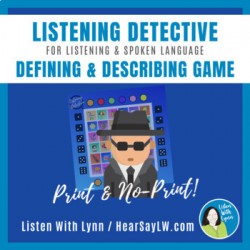
LISTENING DETECTIVE - Defining and Describing Game
$ 7
Kids listen, grow and practice using descriptive vocabulary while expanding complex language skills when playing LISTENING DETECTIVE. Players take turns describing and identifying objects on a colorfu
...
l and engaging game board.➼ The Describer gives the descriptions to the other player(s) targeting expressive language skills. They describe exactly with their words. Acting out is not allowed.➼ The Detective listens to descriptions, creates a picture in their mind then identifies the object targeting auditory comprehension, memory skills, and critical thinking.Teletherapy | Distance Learning | At HomeGOOGLE Drive, DIGITAL AND PRINTABLE! Includes a zipped file that contains✤ A guide and handout for parents, teachers, and therapists with prompts aimed at expanding vocabulary using descriptions and definition✤ Listening and Spoken Language (LSL) Tips for gameplay✤ Digital Game board✤ Printable Game board✤ Link to access Game board through GOOGLE Drive™Teletherapy, Distance Learning & Face to FaceListening Detective can be - ✧ Printed to play at home or in face-to-face sessions.✧ Played using Google Slides™ on a desktop computer, SmartBoard, or teletherapy platform.✧ Played using the interactive PDF on a computer, iPad or teletherapy platforms using PDF reader apps such as the free Adobe Reader DC . In teletherapy, open the PDF, then screen share that window into the teletherapy platform. Use free annotation tools to play.You will need a Google account to access this game in Google Drive!If you want to assign this product to Google Classroom, your students will also need a Google Account.Make a copy for each student.✤ To restore to the original version go file ➼ click the original version to reset for the next gameplay.

Self-Advocacy Bluffing Situations - Never Have I Ever Activity
$ 7
18 Mini-Lessons target BLUFFING and foster self-advocacy and personal responsibility for kids that are deaf and hard of hearing. This resource is based on the NEVER HAVE I EVER game which is fun and m
...
and motivating for elementary and middle school-aged kids.Ideal for: Speech, Listening and Spoken Language, Teachers of the Deaf and Hard of Hearing, Counselors, TeletherapyBluffing is pretending to hear or acting in a way that shows you understand what is being said when you actually are not following the conversation. Bluffing, faking, and pretending are common habits of most people with hearing loss.What's included in this resource:Tips from Pro-Bluffer, Dr. Michelle Hu, a pediatric audiologist and bilateral cochlear implant recipient. Michelle knows what it is like to bluff and shares words of wisdom based on her life experiences. Follow Michelle on Instagram as she shares her hearing loss journey.18 Never Have I Ever Mini-Lessons✧ Real photos that illustrate the social situations and scenarios✧ Each situation pictures a student who says: (example) "Never Have I Ever pretended that I didn’t want to join in the game.”✧ The kids' self-talk or comments. (example) "It’s easier to not play rather than mishear and mess up."✧ Talking points with guided questions/discussion prompts.Children grapple with BLUFFING in challenging situations. Discussing possible plans of action, and exploring positive coping and communication repair strategies within a supported environment is important. Self-advocacy success requires knowledge, skills, and importantly ample practice opportunities.➼ DIGITAL - NO PRINT can be opened and played with your favorite PDF reader app on a tablet. When playing on a computer, open and use a PDF reader such as Adobe Acrobat Reader DC which is free. ➼ PRINT - Print out the 18 situations and a copy of the Discussion prompts and questions.

Self-Advocacy Scenarios Social Events, Celebrations and Settings
$ 7
Ten Self-Advocacy Mini-Lessons with Year-Round Scenarios Featuring Social Events and Settings For Kids That Are Deaf and Hard of Hearing.Ideal for: Speech, Listening and Spoken Language, Teachers of t
...
s of the Deaf and Hard of Hearing, Counselors, TeletherapyEach scenario is made up of 3 parts:➼ Part One Real photos illustrating a challenging listening situation at a celebration, gathering, or holiday event.➼ Part Two Guided questions, talking points, and discussion prompts.➼ Part Three Each scenario has a paired Try This! section with advocacy strategies to guide further learning.★ Digital No-Prep or PlanningEasily used by parents at home, teachers, and therapists both face to face and on tele-platforms. When playing on a computer, open and use a PDF reader such as the free Adobe Acrobat Reader DC. It can be opened and played with your favorite PDF reader app on a tablet or on an iPad.

Self-Advocacy Role Play Real Life Connections
$ 7
Role-Playing offers opportunities to make real-life connections that students face at school, at home, with peers and in their community. Self-advocacy success requires knowledge, skills, and importan
...
ant practice.These Five Role-Playing scenarios are tried and true. They are derived from true situations of actual kids in my therapy practice.The scenarios help them understand the impact of their actions and reactions. They provide opportunities for kids to grapple with challenging situations and explore communication repair strategies within a supported environment.Ideal for: Speech, Listening and Spoken Language, Teachers of the Deaf and Hard of Hearing, Counselors, TeletherapyIncluded in this resource:Content regarding Coping Strategies -Take Charge strategies that lead to positive advocacy outcomes.Escape strategies often lead to negative consequences.Five Scenarios - Two Parts Each1. At School In The Noisy Hallway2. Driving To Soccer3. After the Birthday Party4. Pizza Party Plans5. At The Ice Cream ShopPart One illustrates a communication breakdown due to the speaker, the topic, the environment... The student using Escape or negative strategies.Talking Points follow with questions and prompts are provided for brainstorming and to lead a discussion.Part Two is the scenario again with the new Take Charge - positive strategies Talking Points - prompts are provided for reflection and to lead a discussion on how did everything work out.Digital No-Prep or Planning- Everything is in this digital resource.- This activity can be easily used by parents at home, teachers and therapists both face to face and on tele-platforms.- When playing on a computer, open and use a PDF reader such as the free Adobe Acrobat Reader DC. It can be opened and played with your favorite PDF reader app on a tablet or on an iPad.

 Cookies